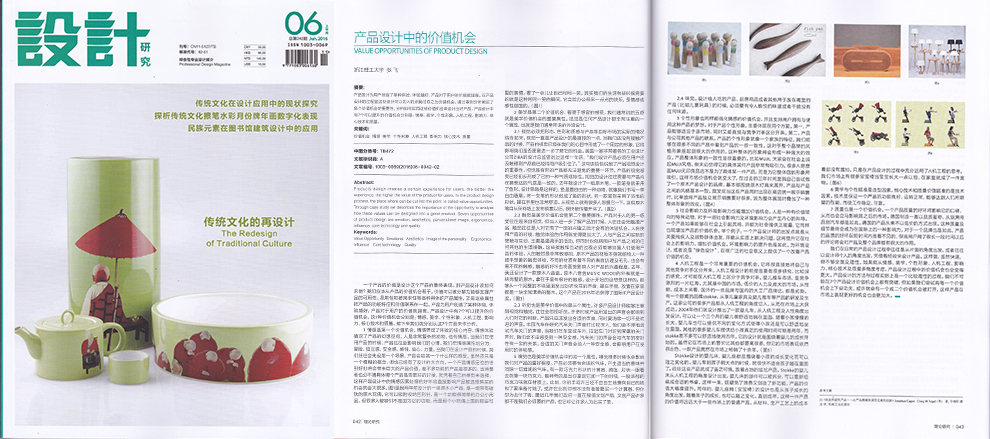
Value opportunities in product design
English Title: Product Design value opportunities
Zhang Fei (Zhejiang University of Technology)
Summary:
Product design creates a certain experience for users, and the better the experience, the higher the value of the product to users.
In the process of product design, these design points that can be addressed are called value opportunities. Through case analysis,
the importance of various value opportunities was explained, and how to use these value opportunities to design good products was analyzed.
There are seven value opportunities that can be enhanced in product design, namely: emotion, aesthetics, personality image, ergonomics, influence, core technology, and quality.
key word:
Value opportunity 2. Emotion 3. Aesthetics 4. Personality image 5. Human machine engineering 6. Influence 7. Core technology 8. Quality
1.The value of a product is the ultimate expression of its design. How should product design be done?
We should start with the value opportunities of the product. Value can be decomposed into various specific product attributes such as usability,
ease of use, and desire that support a product. It is these attributes that link the functional features and value of a product together.
The product creates a certain experience for users, and the better the experience, the higher the value of the product to users.
There are seven value opportunities that can be enhanced in product design. These seven value opportunities are: emotion, aesthetics,
personality image, ergonomics, influence, core technology, and quality. Next, we will analyze each of these seven aspects separately.
Emotions are the first opportunity for value. Emotion defines the core content of experience, and emotional experience determines the fantasy space of the product.
Human beings are very complex animals, they have emotions. When we use products, they often affect our mood.
We divide emotional attributes into adventure, independence, security, sensitivity, confidence, and strength. When we are designing a product,
we often first imagine a scenario and what kind of feeling the product will give me. Although it is still a vague concept, there is already a general direction for design.
The appropriate emotional positioning of a product will bring enormous product value. There are many products with similar functions,
When consumers cannot distinguish which product is better or not, they choose based on their own feelings.
The quality of emotional factors in product design will directly affect the chances of the product being selected for purchase.
This is a set of wooden small products that I designed two years ago. It is a set of wooden dolls with magnets that can absorb and store paper clips.
It is a very simple office accessory. But many people are attracted not because of its functionality, but because of the cute expressions on that little doll.
After watching for a while, I chuckled to myself. In fact, sometimes what we need in our lives is this kind of smiling moment,
which can bring a little bit of happiness to the office, on an emotional or sentimental level.
Aesthetics is the second value opportunity, focusing on sensory experiences.
The five senses we usually refer to are important attributes of aesthetic value opportunities.
Visual design is a crucial attribute in any product design, commonly referred to as appearance design.
2.1. Vision must combine form, color, and texture with the actual situation of the product and target market.
Visual design has always been the most direct aspect of product design. Before we even have the chance to interact with a product,
its visual image has already formed a fixed image in our minds, which will affect our willingness to further understand it.
The design director of ZIBA, a well-known industrial design company in the United States, once said,
"We must design products that attract users before they even touch them." This sentence precisely emphasizes the importance of visual design in products.
Visual perception is an essential aspect that cannot be avoided in tangible products.
The visual perception of the product has initially formed its temperament or characteristics. Visual design often needs to be consistent
with the temperament that the product intends to express internally. Last year, I designed a set of wooden pens, one of which had a fish shaped body.
The design concept is as follows: Fish is the most free animal, just like how we write freely and freely. One pen was shaped like a fish,
while the other pen was shaped like a feather, making it very comfortable to hold in the hand. Visually, many people want to hold it.
Since this set of wooden pens was released for sale online, they have quickly spread.
2.2 Touch is the second important attribute in aesthetic value opportunities. The first impression of a product on people often comes
from visual perception, but when people further understand the product, they tend to touch it first. Touch is often the opportunity
for tactile experience only after people have a certain interest in it. When people use products, the role of tactile experience becomes even more significant.
The actual contact and interaction between people and products mainly emphasizes hand movements,
but also includes any other physiological contact between users and products. These processes of contact and interaction
must enhance people's experience of using the product. Human touch is very sensitive, and the material of natural wood products itself can
give people an unimaginable tactile experience. Different materials have different surface textures and pores, and also have different tactile sensations.
The quality of the touch will also directly affect people's interest in the product. Last year, I designed a wooden music box.
The appearance of the wooden music box MUSIC WOOD is a complete piece of wood, which has a good tactile sensation when held in the hand.
The initial idea of the design was to be able to produce a pleasant and pleasant sound from a complete wooden block, which would be a very beautiful
piece of wood when held in the hand or placed at home. This product also won the International IF Product Design Award in 2015.
2.3 Hearing is also the third attribute of aesthetic value. Many product designers are able to pay attention to visual and tactile cues,
often overlooking auditory cues. Many times, the sound produced by a product can affect people's judgment of it. Products should
only produce appropriate sound while eliminating all unwanted sounds. Toyota has conducted in-depth research on the sound of car doors closing.
They constantly test the sound of car doors closing. When we hear a heavy closing sound when we pull up the door inside or outside the car,
we cannot help but feel a sense of security. The sound of a car closing its door is somewhat related to the car's sealing performance.
The appropriate closing sound can give people a sense of security and affect the user's experience during use.
2.4. Smell is also another attribute of aesthetic value opportunities. Smell often affects our level of preference for products.
The product must have a suitable odor, produce an appropriate fragrance, and eliminate all unpleasant odors.
There is a chocolate shaped calculator that looks like a piece of chocolate in color and shape at first glance.
The most amazing thing is that when you pick it up and smell it, a strong chocolate flavor is reflected in the material.
At this moment, your hand may have involuntarily touched your wallet to prepare to pay.
Perhaps at this moment, you are not even prepared to buy a calculator, but you have paid for it. In recent years,
our government has been promoting cultural and creative products. Many cultural and creative products are not necessary for us,
but they have made many people buy for them.
2.5 Taste. When designing products, kitchen utensils, or other products for putting in the mouth (such as children's toys), they must have a pleasant taste or have no taste at all.
3. Personal image can also enhance emotional value opportunities and support users' dreams of owning and using this product.
The personality image of a product is mainly reflected in two aspects. Firstly, the product is able to adapt to the market while directly
distinguishing itself from competitors. Secondly, the connection between the product and other products of the company.
The personality image of a product is like the characteristics of a family, and we can see some consistency in many different products.
This has a significant impact on the overall style and image of the brand, creating a powerful effect on the overall image.
The consistency of the overall image of the product is very important. For example, MUJI, which is commonly referred to as MUJI style in society,
may not necessarily be very attractive to a specific product. Many people are willing to visit MUJI MUJI stores not for a specific product,
but for the overall image of the store. This increases the market value opportunity. In the past three years, I have tried to create a brand
of wooden product design on my own, mainly focusing on wooden lighting fixtures, with similar styles between products.
I have found that it is much better to display and sell these products together in a unified store than to display and sell them separately, because the overall display adds an overall image effect.
4.Human engineering is a very important value opportunity. It will directly differentiate itself from other competitors.
The premise of human-machine engineering design is to conduct a lot of research, in-depth research, in order to distinguish
itself from competitors in human-machine engineering. The baby stroller market is a fiercely competitive red ocean. Especially in the
Chinese market, with low-priced labor and a huge market. In terms of performance and cost, some foreign brands are at a disadvantage
compared to domestic large factory brands. There is a Norwegian brand Stokke that engages in the research and production of
children's furniture and baby strollers. Many of the products of this company are approached from the perspective of ergonomics,
resulting in great success in the market. In 2004, they designed and launched a baby stroller that was designed from the perspectives
of ergonomics and human nature. It allows a three month old baby to comfortably lie inside, and as the child grows up,
the stroller can also provide different ways to make the child sit comfortably inside. Many other baby strollers provide children with a real usage time of two years,
while Stokke can be comfortably used for about four years. Its design revolves around the growth of infants.
Although its price in the market is much higher than others, its market performance is still outstanding, and a product has been selling well in the market for more than ten years.
Stokke's baby crib and baby seat are designed to adapt to the changes in a child's growth. When the baby stroller reaches a slightly older age,
the child quickly becomes unsuitable for sleeping inside. Often these products become a pity to be lost, as they occupy an awkward amount of space.
Stokke's crib is designed from the perspective of ergonomics, where the components of the crib can be disassembled
and reassembled into a suitable desk. In this way, it not only avoids waste but also creates new features, greatly increasing the value of the product.
Similarly, the design of baby seats (baby chairs) is also based on the perspective of a child's growth, and as the child grows,
they can also change accordingly. Until adulthood. The value of such a product will far exceed that of some ordinary products in the market.
From the perspective of material and production process costs, there has been no increase.
Just fully utilizing the thinking of ergonomics in the product design process. There are many baby chairs in our market that become useless at home when babies grow up a little.
5. Social and environmental influence can also increase value opportunities.
Human beings are special animals with valuable tendencies, and they can resonate with certain social and environmental influences.
If a product can resonate with society and provide positive energy, it can also increase the value opportunities of the product.
For example, a product designer's starting point can be to care for people with disabilities and vulnerable groups,
and to solve problems in essence, which will enhance its influence in society and increase value opportunities.
The same applies to the enhancement of environmental influence. Environmental design, or "green design," provides an opportunity to improve product value in a broad social sense.
6.Aesthetics and personality targeting are styling factors. The core technology and quality value aim at technological factors.
Technology is to ensure that a product functions well, operates normally, achieves the expected performance, and makes the work stable and reliable.
7.Quality is also a valuable opportunity. The quality of a product will affect its reputation and immediately impact its future market.
German manufacturing has always been known for its quality, from kitchen supplies to cars. German products never appear in a low-priced manner.
This quality and detail will ultimately become an influence internationally. The same goes for a brand, the quality of a product may not be visible in the short term,
but after a long period of use, user reviews can have a significant impact on the product and the entire brand.
In our daily product design process, we often start from a one-sided perspective or from the designer's personal perspective, relying on experience to design products.
This approach, although fast, is not comprehensive and rational enough. If we can consider from multiple perspectives such as emotions, aesthetics, personality image,
ergonomics, influence, core technology, and quality, the value opportunities in the product design process will also become greater.
The method and process of product design is actually a relatively rational process. We cannot make breakthroughs in all 7 product design value opportunities,
but if we try to put in more effort on each value opportunity, perhaps one or two value opportunities will be opened up. This will increase the chances of the product performing better in the market.

